
OKR vs KPI in Jira: Stop Treating Key Results as Tasks
This is one of the most-searched questions in the goal-setting space, so let me answer it directly first, then get into where it actually goes wrong in practice.
The real difference, in one line#
A KPI monitors stability. An OKR drives change. Atlassian’s own framing of it holds up well: KPIs track steady-state performance, while OKRs exist to force significant improvement inside a fixed window. A KPI for monthly active users just watches the number. An OKR might set out to grow that number by 20% this quarter — same metric, completely different job.
That distinction sounds simple, and it is. It’s also almost never where goal-tracking actually breaks down.
The mistake the title is about#
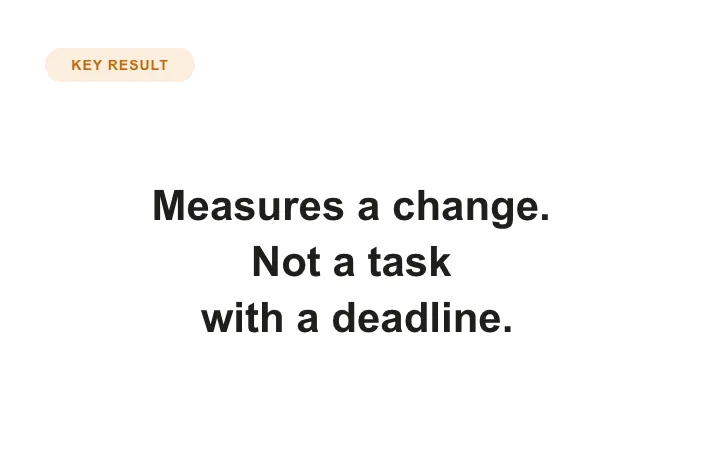
Here’s the pattern that causes more damage than any framework confusion: a team writes a Key Result that’s really just a task with a due date. “Ship the new onboarding flow by June 15” gets written down as a Key Result. It has a deadline, it sounds concrete, it feels like progress. It isn’t a Key Result — it’s a task wearing a Key Result’s clothes.
OKR coach Felipe Castro names this as the single most common failure mode: “using OKR to track projects and due dates instead of achieving outcomes”. Shipping the onboarding flow isn’t the point. Whatever the onboarding flow was supposed to change — activation rate, time-to-value, support ticket volume — that’s the Key Result. The task is just the work you did to try to move it.
The same confusion runs the other way, too, and it’s exactly why the title says “vs” instead of “or”: teams sometimes flatten a KPI into a temporary OKR, or a Key Result into a permanent KPI, because their tool only gives them one kind of box to put things in. A KPI like “customer churn” doesn’t get “achieved” and closed out at quarter-end — it needs to keep being watched indefinitely, in a healthy or unhealthy band, forever. An Objective does close. Mixing the two into one flat list is how you end up with a “goal” that never resolves sitting next to a “metric” that gets abandoned the moment the quarter ends.
And even where the framework itself is right, execution is where it actually dies. Real numbers back this up: across more than 21,000 strategic plans studied by ClearPoint Strategy, only 27% of KPIs and 10% of objectives are actively scored, and the large majority of people who own a metric have never once recorded an update against it. The framework — OKR, KPI, whatever you call it — was rarely the actual problem. Ownership and follow-through are.
Where Strategy Hub picks this up#
If the failure mode is collapsing two structurally different things into one undifferentiated list, the fix isn’t a better naming convention — it’s a tool that treats them as genuinely different Types from the start, not just different labels on the same kind of box.
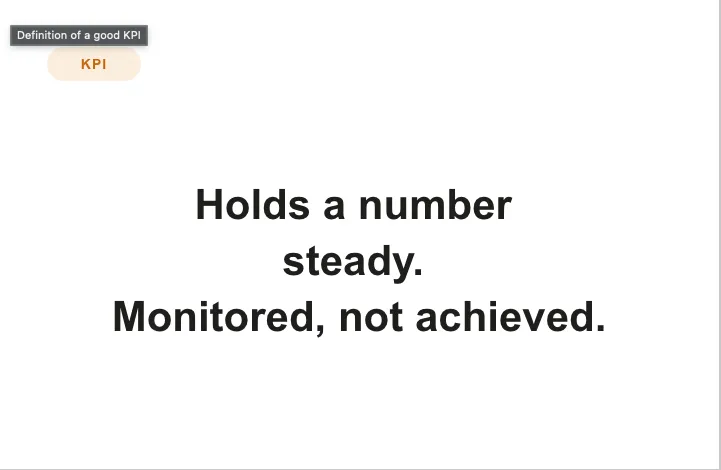
- Objectives, Key Results, and KPIs are distinct Types, not the same Item renamed. A Key Result belongs to an Objective and is expected to resolve — it has a start, a target, and an end. A KPI is freestanding and ongoing — it’s monitored continuously, with a healthy band rather than a finish line, and it doesn’t need a parent Objective to exist. The structure itself won’t let a permanent metric masquerade as a temporary goal, or vice versa.
- The OKR + KPI preset tracks both side by side out of the box. Rather than forcing a choice between “we’re an OKR shop” or “we’re a KPI shop,” this preset sets up Objectives and Key Results for what you’re actively pushing to change this quarter, alongside a separate KPI layer for the metrics you’re committed to holding steady — visible together, without either one distorting the other’s shape.
- Filtering and dashboards respect the difference. Because Type is a real property, not just a label, you can build a view of only this quarter’s Key Results that are actually behind, or a dashboard of KPIs that have drifted out of their healthy band — without the never-ending metrics cluttering the “what are we changing right now” view, or the temporary goals cluttering the “is the business healthy” view.
- Nothing forces a Key Result to look like a task. Because Key Results live as their own Type tied to progress and a target, not a checklist item, the structure itself nudges toward writing “reduce churn from 6% to 4%” rather than “ship the retention campaign” — the outcome, not the work that might produce it.
None of this replaces the discipline Felipe Castro and ClearPoint’s data both point to — someone still has to actually update the numbers, and no Type system fixes an unowned metric. What it does is stop the tool itself from quietly encouraging the exact mix-up the title is about.