
Is it hard to start tracking goals properly? Yes. And also, no.
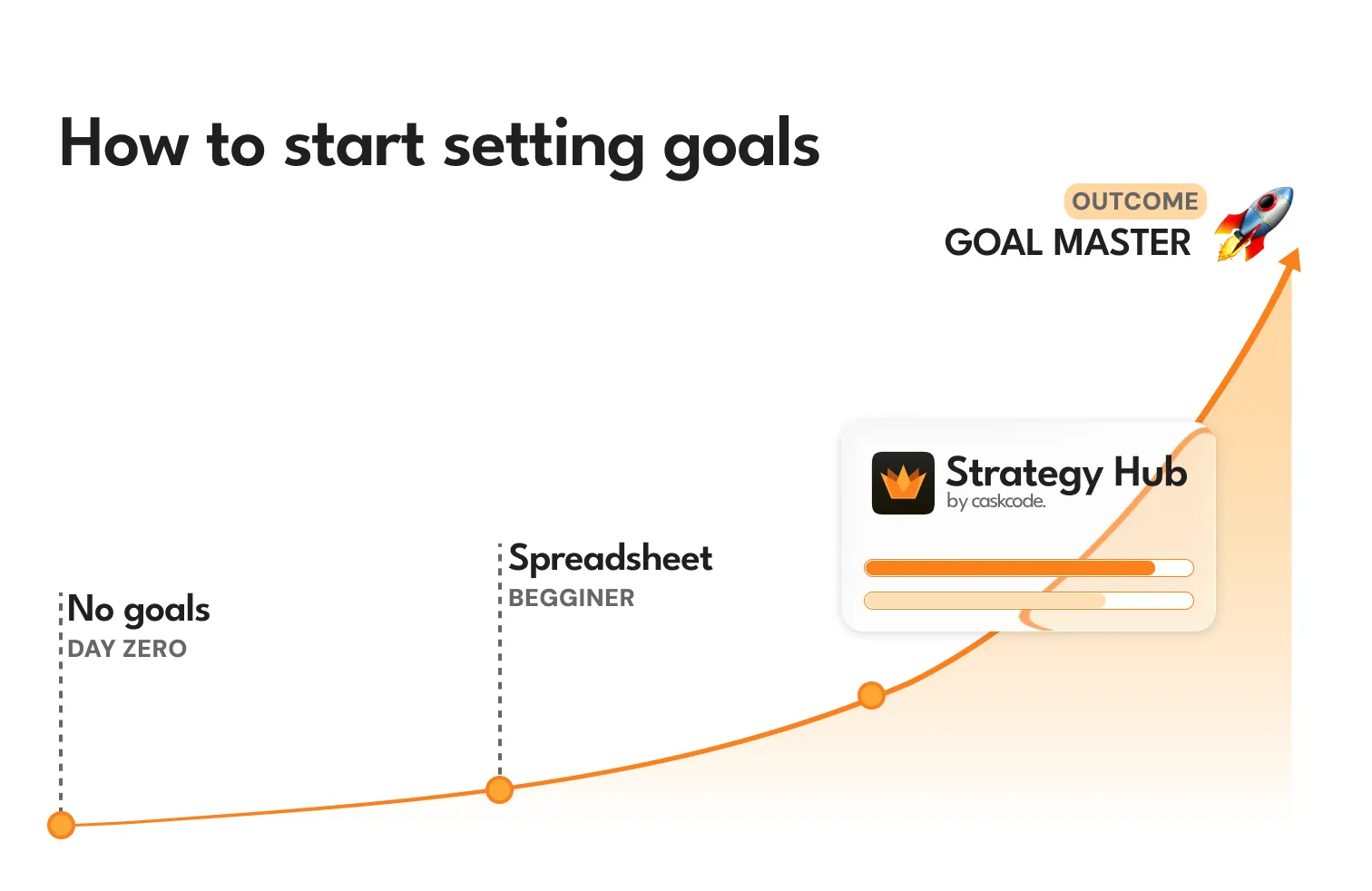
Someone asked me recently, pretty directly: is it hard to start using a dedicated tool for goal tracking? I sat with that question longer than I expected to, because the honest answer is both yes and no — and I think both halves are worth actually saying out loud, instead of picking whichever one makes a better sales pitch.
The case for “yes, it’s genuinely hard”#
If you’re setting up OKRs, or a KPI framework, or honestly most structured goal-setting methods, there’s real work before any tool helps you:
- You need to actually understand the framework you’re adopting — not just the acronym, but what an Objective is for versus what a Key Result measures, and why that distinction matters.
- You need to get people aligned on it, which is a people problem, not a software problem.
- You need someone who owns it — a champion who keeps the thing alive after the kickoff enthusiasm fades, because without one it quietly stops updating within a quarter.
- You need an actual education process, so people don’t just nod along in the kickoff meeting and then go back to running things exactly as before.
- You need to keep updating it, on a cadence, indefinitely — the hardest part of any goal system isn’t setting it up, it’s still doing it in month four.
- And most subtly: you need real discipline to keep a goal a goal, not a task list or a KPI wearing a goal’s clothes.
That last point is the one experienced practitioners flag most often. OKR coach Felipe Castro has spent years pointing out that the most common failure mode is (cite index=“39-1”>using OKR to track projects and due dates instead of achieving outcomes — teams write “ship the new onboarding flow by June” and call it a Key Result, when that’s a task, not a measure of whether anything actually got better.
There’s an even sharper warning worth including, because it directly contradicts the instinct to just copy what worked for someone else: for years, the most-watched explanation of OKRs was a single Google Ventures video by Rick Klau. It was genuinely useful — and also never meant to be gospel. Castro’s own read on what happened next is blunt: (cite index=“32-1”>many people try to follow the video to the letter, and they fail horribly. The lesson isn’t “don’t learn from good examples” — it’s that a framework followed rigidly, without adapting it to your own org, is its own failure mode. Rigor and rigidity aren’t the same thing.
So yes — genuinely hard, in all the ways that have nothing to do with which app you pick.
The case for “actually, it’s easier than you expect”#
Here’s the part that gets missed. Almost nobody starts from zero. If your finance team hands down a revenue target for the quarter, if your team already argues about what “done” means for the next release, if leadership has ever said “here’s what we’re steering toward this year” — you already have the raw material. What’s usually missing isn’t the goal-setting instinct, it’s the shape. It’s sitting in someone’s head, a slide deck, or a spreadsheet, instead of somewhere that cascades, updates, and connects to the actual work.
UX strategist Christina Wodtke makes essentially this point about OKRs specifically: the Objective is just an honest answer to “why are we doing this project,” a question most teams have already half-answered without writing it down formally. You’re not inventing intent from scratch. You’re giving intent you already have a structure sturdy enough to survive a quarter.
That reframes the real question. It’s not “can we do goal-setting” — most teams already are, informally. It’s “can we do it without it collapsing into a spreadsheet nobody opens after week two.” That’s a tooling and habit problem, and it’s a much smaller one than “understand an entire strategy framework from scratch.”
Where this leaves Strategy Hub#
If starting is hard because of the framework-and-people half, and easy because you already have raw material, the right job for a tool is: don’t add friction to the hard half, and don’t waste the easy half.
Concretely, here’s what that means in actual setup flow of Strategy Hub:
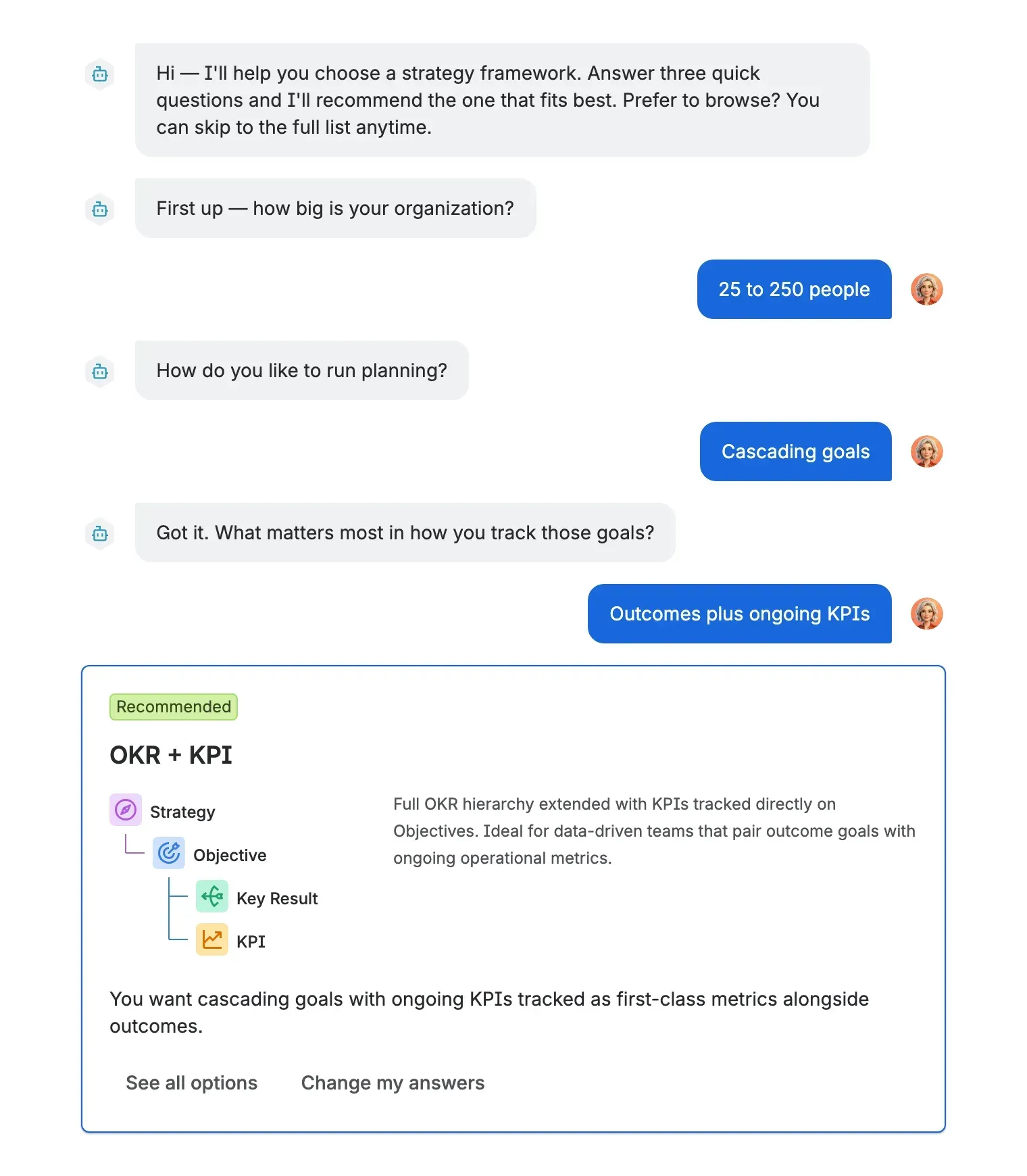
- You don’t need to know a framework going in. The setup wizard opens with three short questions about your org’s size and planning style, and recommends one of eight presets — Simple OKR, full OKR, OKR + KPI, OGSM, Hoshin Kanri, EOS, North Star, or 4DX — instead of handing you a blank hierarchy and a glossary. Don’t want to answer questions? Skip straight to comparing all eight side by side.
- Whatever you pick isn’t a commitment. Every Type, nesting rule, and Status a preset creates is editable afterward in Settings. Pick the closest shape, rename the levels to match how your org already talks, and move on — rebuilding a hierarchy from empty is the slow path; renaming an existing one is fast.
- Your existing mess is a valid starting point. If your “goals” currently live in a spreadsheet, the setup wizard’s data step lets you import that CSV directly, validated against whatever framework you picked, instead of asking you to start over. If you’d rather see the shape of things before committing real data, it can generate sample Items matching your framework instead.
- There’s a recommended default at every fork, not just a blank form. Permissions default to Collaborator as the baseline role — enough access to actually use the tool without a separate setup conversation about who can do what. Progress rollup, Jira team sync, the Rovo agent, the linked-issue panel — every toggle in setup ships with a sensible default you can leave alone.
- The first real payoff doesn’t require finishing the whole framework. Create one Item, link it to real Jira work, and you already have a live view — the Dashboard, the Portfolio board, or a plain filterable table — showing something true, instead of waiting until the “full rollout” to see any value.
- The native Rovo agent covers a chunk of the “champion” and “education” burden. A lot of what makes goal-setting hard early on is just not knowing where to look or what to ask — someone has to answer “what’s the status of the Q3 objective” or “which Key Results are behind.” Strategy Hub’s Rovo agent, reachable from in-app buttons or Rovo Chat, answers exactly those questions in plain language, in context, without anyone digging through views by hand. It goes a step further than Q&A, too: you can ask it to draft Objectives or Key Results and link them straight to the relevant Jira issues, so the step that normally eats the most setup time — translating a plan into structured Items wired to real work — starts as a conversation instead of a form.
None of this erases the hard half — you still need a champion, you still need people actually looking at it in month four, and Rovo drafting a Key Result for you doesn’t help if nobody checks whether it’s measuring an outcome or just a task in disguise. What good setup can do is stop the mechanics themselves from being the reason a genuinely good habit never gets off the ground.